

What is multi-cloud?
What is multi-deject?

A multi-cloud approach is i in which a business uses more than one cloud platform or application, each for a specific purpose. This includes the best deject storage platforms, applications similar Slack, productivity suites like Microsoft 365 or Google Workspace, and other services including Amazon Spider web Services and Microsoft Azure.
Unsurprisingly, the vast majority of businesses - whether they realize it or non - have adopted this method, using a combination of public (and sometimes private) cloud environments in 24-hour interval-to-day operations. In this article, we'll take a closer look at multi-cloud environments, and the most mutual advantages and challenges associated with them.
Why practice businesses use multi-cloud environments?
Near businesses adopt a multi-cloud approach because no unmarried, perfect solution is known to them (or fifty-fifty likely to exist). To empathize why, permit's take a closer look at deject computing in general.
Deject calculating tin can be divided into three main categories: infrastructure as a service (IaaS); platform every bit a service (PaaS); and software as a service (SaaS).
IaaS, the virtually basic level, provides a nearly empty virtual environment for businesses to build custom solutions. It'south theoretically possible to build a single solution that addresses all aspects of a business organisation'due south operations, but information technology would be extraordinarily complex, plush, and difficult to maintain.
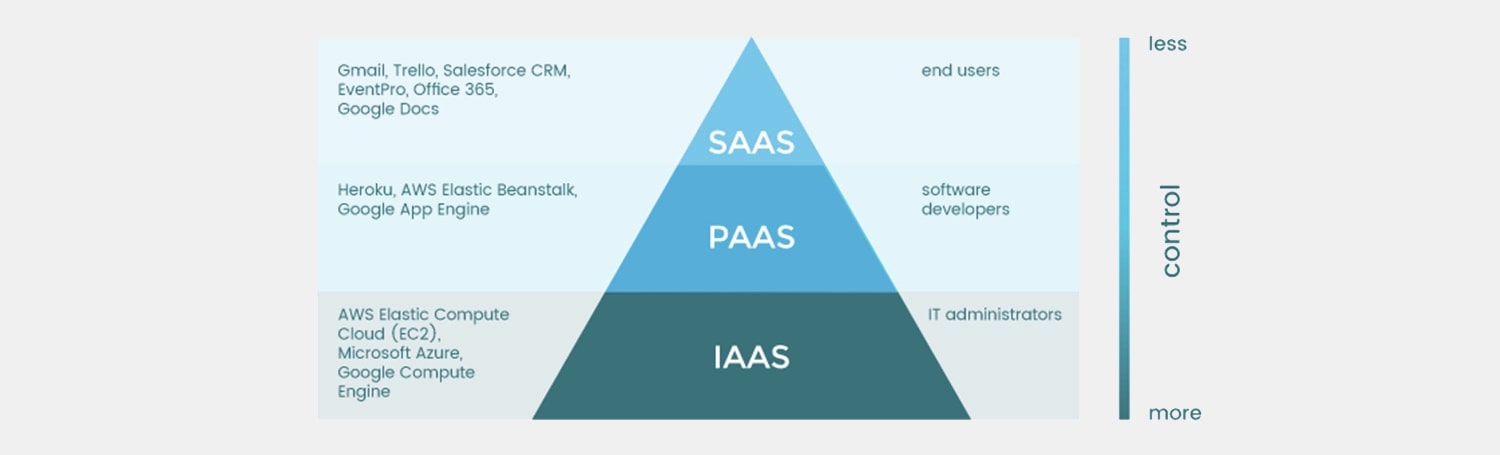
Unable or unwilling to invest in such a huge undertaking, about businesses thus prefer to apply a combination of IaaS, PaaS, and SaaS to meet business organization objectives. PaaS and SaaS providers offering lower-level solutions: platforms dedicated to a item objective and software that responds to specific needs, like communication and collaboration.
Rather than building everything from the footing up, companies prefer to pick and choose from different cloud solutions, cobbling them together to attain sure goals, and thus making use of a multi-deject environment. A company that uses Slack for communication, Microsoft 365 for collaboration, Sage for accounting, and Bamboo for human resources and payroll is one that has adopted a multi-cloud approach.
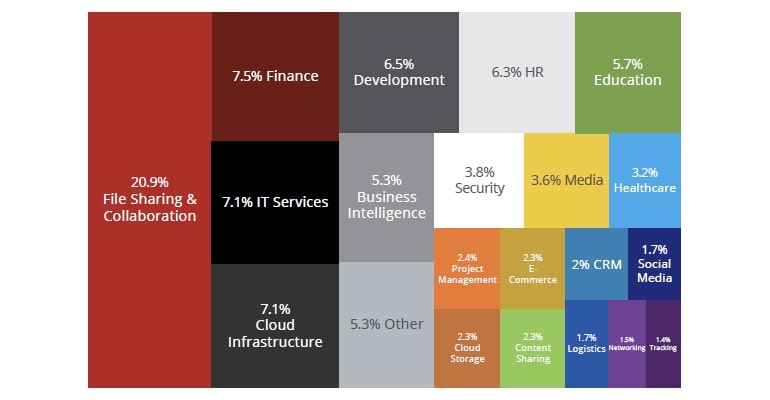
Additionally, different departments and locations which work semi-independently are likely to adopt different deject services based on their needs (or simple familiarity). This is well demonstrated past a 2019 McAfee report in which 1,400 IT professionals were asked how many cloud services their company used. The average response was 34. The bodily number, on average, was 1,935.
Multi-cloud should non be confused with a hybrid cloud solution, in which a business concern uses both public cloud services in conjunction with a private, "on-premises" cloud of their own. A private cloud follows the aforementioned principles every bit a public one, except that users - and particularly the business's customers - do not interface with it direct. Instead, data is exchanged between private and public clouds, the latter of which is customer-facing.
A hybrid cloud environment is thus characterized by the integration of public and private deject platforms, while a multi-deject approach refers principally to the utilize of multiple public deject platforms by a single business.
What are the advantages of using a multi-cloud arroyo?
There are a few important advantages to a multi-cloud environs. One of the well-nigh obvious is the flexibility that comes with combining different cloud platforms rather than placing all of one'southward eggs in a single handbasket, as it were. Y'all avert being "locked in" with a single vendor, and thus being limited by its strengths and weaknesses.
Of course, this as well gives leverage to businesses when negotiating with vendors. The former are free to compare providers and products, and the latter are highly incentivized to provide an industry-leading product at competitive rates. A business with a multi-deject environment tin can more hands alter service agreements than 1 whose mission-critical functions are tied into a unmarried platform.
A multi-deject environment likewise enables businesses to add together and remove functions and applications as needed. Thus, every bit departments abound or are added and missions change, a business can simply add a new cloud service to fulfill this need. This too adds in scalability, equally a company can bandy vendors if they outgrow a smaller one.
What challenges do multi-cloud environments pose to businesses?
Of course, the many moving parts associated with a multi-cloud surroundings mean that there are more opportunities for something to go wrong. While in principle different platforms and applications should work together seamlessly, this is not always the example.
Thus, the demands on Information technology professionals can exist farthermost as different departments, locations, and even individuals adopt different solutions (the boilerplate company in McAfee's survey made use of more than than 1,900 different cloud services).
These inconsistencies tin have important and far-flung consequences on workflow and management, as well. Dissimilar teams may apply unlike software to achieve the same ends, thus making it difficult to streamline practices company-wide. File and information sharing too suffer, equally different service agreements result in discrepancies in versioning and file history, the size of files that tin be uploaded or manipulated, and even how files are read or acted upon.
Unsurprisingly, all of this complicates training as well, and makes it more hard to ensure regulatory compliance. Major skill gaps can develop between staff in unlike departments or locations. Furthermore, the number of different platforms in use is inversely proportional to the number of skilled applicants bachelor for hire.
Security is another of import concern. Starting time, different cloud environments may prefer different security measures of greater or lesser strengths, and finding weaknesses in a multi-deject environment is much more than difficult than on a unmarried, unified platform.
Patching those weaknesses is more difficult, too - a correction on one platform may pause an important integration or disrupt a critical workflow. Multiple environments can also mean multiple passwords, encouraging employees to adopt poor countersign habits.
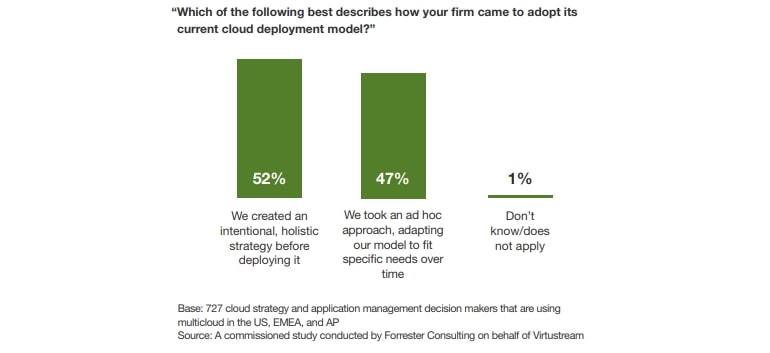
Many of these challenges can be mitigated or avoided entirely by carefully planning out 1'southward multi-cloud environment: that is, past deciding what functions are needed, researching a diverseness of providers that claim to come across these needs, and determining how well they will piece of work in concert.
Unfortunately, co-ordinate to a study by VirtuStream, merely a narrow bulk of businesses have taken this arroyo. Research has shown that 47% add cloud platforms and applications in an ad-hoc mode, opening the door to imperfect integrations and many of the challenges cited above.
Conclusion
Despite the challenges posed by multi-cloud environments, most businesses still choose to adopt this approach. This is partly due to the advantages associated with such an environment, just also because it's tremendously difficult to find (or expensive to create) a single solution that responds to every aspect of a business organization' operations.
Multi-cloud environments, in which a variety of cloud applications and platforms are used together to accomplish concern objectives, enable businesses to grow and adapt to customer needs. If you're interested in finding out more than, read our feature that explains why a multi-cloud strategy benefits businesses.

Source: https://www.tomsguide.com/features/what-is-multi-cloud
Posted by: lillibridgeaceis1966.blogspot.com
0 Response to "What is multi-cloud?"
Post a Comment